





Is TMS for Depression a Cost-Effective Investment in the UK?
February 20, 2026 - Smart TMS


Treatment-Resistant Depression (TRD)
Depressive disorders have been ranked as the second highest disease burden globally (Global Burden of Disease, 2024), currently affecting approximately 322 million people (World Health Organization, 2025). This burden increases further in individuals presenting with treatment-resistant depression (TRD) (McIntyre et al., 2023).
Whilst there is no single universally agreed definition of TRD, it is commonly described as a form of depression that does not respond to conventional treatments, resulting in significantly reduced quality of life (McIntyre et al., 2023). More formal definitions, including those provided by the US Food and Drug Administration (FDA) and the European Medicines Agency (EMA), describe TRD as major depressive disorder that has not responded to at least two adequate trials of antidepressant medication.
The high disease burden of TRD, combined with its poor response to standard pharmacological and psychological therapies, highlights the need for accessible, evidence-based alternatives that prioritise both clinical outcomes and long-term service sustainability.
TMS as a Treatment for Treatment-Resistant Depression
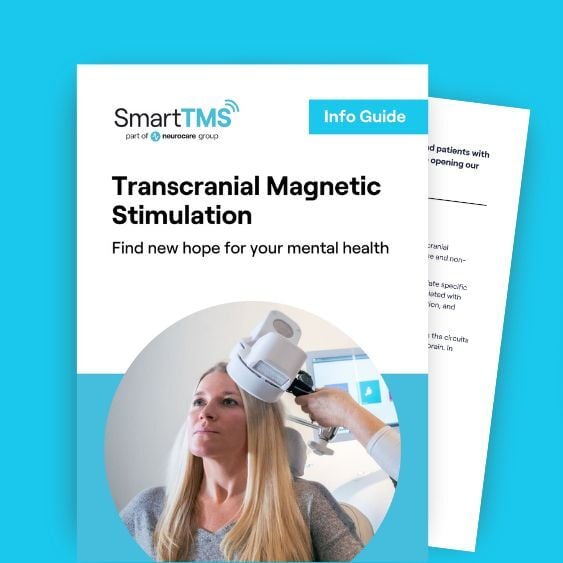
Transcranial Magnetic Stimulation (TMS) is a non-invasive, NICE-recognised neuromodulation therapy that has been increasingly established as an effective treatment for depression (Akpinar et al., 2022; Lohr, 2014).
Repetitive Transcranial Magnetic Stimulation (rTMS) uses magnetic pulses to induce changes in electrical activity in targeted brain regions implicated in depression, promoting neuroplasticity (Latoussakis et al., 2017). Research consistently demonstrates that TMS for depression is significantly more effective than sham treatment and provides meaningful symptom reduction in individuals with treatment-resistant depression (Bulteau et al., 2022; Lohr, 2014).
Importantly, rTMS:
- Does not require anaesthesia
- Is well tolerated
- Does not carry the systemic side effects associated with antidepressant medication
- Allows patients to return to normal activities immediately following treatment
In addition to its established role in major depressive disorder, there is growing evidence supporting TMS for anxiety symptoms, particularly where anxiety co-occurs with depression — a common clinical presentation in UK services.
Despite the expanding evidence base and NICE guidance, TMS treatment in the UK remains underutilised, often due to misconceptions surrounding cost and implementation.
This blog explores whether rTMS represents a cost-effective investment within UK mental health services.
Cost-Benefit Evaluation of rTMS for TRD
To determine the clinical and economic value of rTMS in treating treatment-resistant depression, Cox et al. (2026) conducted a UK-based cost-effectiveness model comparing rTMS with treatment as usual (TAU) for adults with moderate to severe TRD.
This analysis estimated two key outcomes:
- The cost of treatment
- The benefit measured in quality-adjusted life years (QALYs)
One QALY equates to one year of life in perfect health. By measuring increases in QALYs, researchers can determine which treatments provide the greatest overall health benefit relative to cost.
The model evaluated outcomes over an 18-month period, incorporating impacts on NHS resource utilisation as well as wider societal costs, including informal caregiving and productivity losses. Cost-effectiveness was measured using incremental cost-effectiveness ratios (ICERs), compared against NICE thresholds (£20,000–£30,000 per QALY).
Outcome of the Cost-Effectiveness Model
Findings from Cox et al. (2026) demonstrated that rTMS is cost-effective when compared to treatment as usual for moderate to severe treatment-resistant depression.
From a healthcare perspective, rTMS significantly reduced depressive symptoms, leading to:
- Reduced wider healthcare usage
- Decreased reliance on secondary and crisis services
- Lower informal care burden
- Improved productivity outcomes
Although rTMS involves an initial upfront treatment cost, the longer-term reduction in healthcare utilisation and societal burden results in favourable economic outcomes.
Crucially, rTMS was found to be well within NICE cost-effectiveness thresholds (£20,000–£30,000 per QALY), providing strong economic justification for improved access to TMS for depression in the UK.
Conclusion and Implications for Future Service Provision
The economic evaluation by Cox and colleagues (2026) provides compelling evidence that rTMS therapy is both clinically effective and cost-effective for moderate to severe treatment-resistant depression.
Importantly, the paper emphasises that cost-effectiveness is contingent on:
- Appropriate patient selection
- Efficient service delivery
- Streamlined treatment pathways
Efficient delivery refers to maintaining high throughput, minimising delays between sessions, and ensuring treatment is delivered by experienced practitioners within well-governed services.
Expanding access to TMS therefore requires not only awareness of the evidence base, but thoughtful implementation models that prioritise clinical expertise, operational efficiency, and patient outcomes.
Collaborative referral pathways to established TMS providers may offer a pragmatic approach to widening access while maintaining economic sustainability and high standards of care.
As the burden of treatment-resistant depression continues to rise, improving access to evidence-based, non-invasive treatments such as rTMS will remain an important component of modern mental health service provision.
For services, clinicians, and commissioners seeking to better understand how TMS for depression can be integrated into existing pathways, ongoing dialogue, research collaboration, and shared expertise will be key to ensuring patients receive timely access to appropriate care.
Written by Lavina, our Smart TMS Edinburgh practitioner
References
-
Akpinar, K., Oğuzhanoğlu, N., & Uğurlu, T. (2022). Efficacy of transcranial magnetic stimulation in treatment-resistant depression. Turkish Journal of Medical Sciences, 52(4), 1344–1354. https://doi.org/10.55730/1300-0144.5441
-
Bulteau, S., Laurin, A., Pere, M., Fayet, G., Thomas-Ollivier, V., Deschamps, T., Auffray-Calvier, E., Bukowski, N., Vanelle, J.-M., Sébille, V., & Sauvaget, A. (2022). Intermittent theta burst stimulation (iTBS) versus 10 Hz high-frequency repetitive transcranial magnetic stimulation (rTMS) to alleviate treatment-resistant unipolar depression: A randomized controlled trial (THETA-DEP). Brain Stimulation: Basic, Translational, and Clinical Research in Neuromodulation, 15(3), 870–880. https://doi.org/10.1016/j.brs.2022.05.011
-
Cox, E., Ma, J., Roadevin, C., Morriss, R., & James, M. (2026). Is it time for mental health services to invest in neurostimulation? An economic evaluation of transcranial magnetic stimulation therapies for the treatment of moderate to severe treatment-resistant depression in the UK. BMJ Mental Health, 29(1). https://doi.org/10.1136/bmjment-2025-302237
-
European Medicines Agency. Clinical investigation of medicinal products in the treatment of depression – Scientific guideline. Amsterdam: European Medicines Agency, 2018.
-
Global Burden of Disease Collaborative Network. (2024). Global Burden of Disease Study 2021 (GBD 2021) results. Institute for Health Metrics and Evaluation. Available from https://vizhub.healthdata.org/gbd-results/
-
Latoussakis, M. M. H., Shirlene M. Sampson, Linda L. Carpenter, Andrew D. Krystal, Ian A. Cook, Shawn M. McClintock, Sarah H. Lisanby, Irving M. Reti, William M. McDonald, Marc Dubin, Stephan F. Taylor, John O’ Reardon, Christopher Wall, Oscar Morales, Brent G. Nelson, Mark S. George, Vassilios. (2017, May 23). Consensus Recommendations for the Clinical Application of Repetitive Transcranial Magnetic Stimulation (rTMS) in the Treatment of Depression. Psychiatrist.Com. https://www.psychiatrist.com/jcp/consensus-recommendations-for-applying-rtms-in-mdd/
-
Lohr, B. N. G., Richard A. Hansen, Stacey W. Lloyd, Linda Lux, Gerald Gartlehner, Shannon Brode, Daniel E. Jonas, Tammeka Swinson Evans, Meera Viswanathan, Kathleen N. (2014, May 15). Repetitive Transcranial Magnetic Stimulation for Treatment-Resistant Depression: A Systematic Review and Meta-Analysis. Psychiatrist.Com. https://www.psychiatrist.com/jcp/repetitive-transcranial-magnetic-stimulation-treatment-2/
-
McIntyre, R. S., Alsuwaidan, M., Baune, B. T., Berk, M., Demyttenaere, K., Goldberg, J. F., Gorwood, P., Ho, R., Kasper, S., Kennedy, S. H., Ly-Uson, J., Mansur, R. B., McAllister-Williams, R. H., Murrough, J. W., Nemeroff, C. B., Nierenberg, A. A., Rosenblat, J. D., Sanacora, G., Schatzberg, A. F., … Maj, M. (2023). Treatment-resistant depression: Definition, prevalence, detection, management, and investigational interventions. World Psychiatry, 22(3), 394–412. https://doi.org/10.1002/wps.21120
-
World Health Organisation. (2025). Depressive disorder (depression). Retrieved February 12, 2026, from https://www.who.int/news-room/fact-sheets/detail/depression
-
U.S. Food and Drug Administration. Center for Drug Evaluation and Research. Major depressive disorder: developing drugs for treatment. Silver Spring: U.S. Food and Drug Administration, 2018.