





How OCD Affects Daily Life and How TMS May Help | Smart TMS
January 15, 2026 - Smart TMS


Obsessive-Compulsive Disorder (OCD) is a complex and often misunderstood mental health condition that can significantly impact a person’s day-to-day life. Far more than a preference for order or cleanliness, OCD is a debilitating condition characterised by intrusive thoughts and repetitive behaviours that can consume hours each day and interfere with work, relationships, confidence, and overall wellbeing.
At Smart TMS, we work with individuals experiencing OCD, depression, anxiety, and other mental health conditions, offering evidence-based treatments such as Transcranial Magnetic Stimulation (TMS) to support recovery when traditional approaches have not been effective.
What Is OCD?
OCD is a mental health disorder defined by the presence of obsessions, compulsions, or both.
-
Obsessions are unwanted, intrusive thoughts, images, or urges that cause significant distress.
-
Compulsions are repetitive behaviours or mental acts performed to reduce anxiety or prevent a feared outcome.
Common obsessions include fears of contamination, harm, making mistakes, or acting against one’s values. Compulsions may involve excessive checking, washing, counting, repeating phrases, reassurance-seeking, or mental rituals.
Importantly, people with OCD usually recognise that their thoughts and behaviours are excessive or irrational — yet still feel unable to stop them.
How OCD Affects a Person’s Day-to-Day Life
OCD can affect almost every aspect of daily living. Tasks that seem simple to others — getting dressed, leaving the house, sending an email — can become exhausting and time-consuming for someone with OCD.
Impact on Daily Routine
-
Morning and evening routines may take hours due to checking or repeating behaviours
-
Work and academic performance can suffer due to difficulty concentrating
-
Social plans may be avoided because of fear, shame, or rigid routines
-
Decision-making can feel overwhelming due to fear of “getting it wrong”
Many people with OCD feel trapped in cycles that dominate their schedule, leaving little time or energy for rest, enjoyment, or relationships.
How Someone With OCD Thinks
OCD is driven by a heightened sense of responsibility, threat perception, and intolerance of uncertainty. Common thinking patterns include:
-
“If I don’t do this, something bad will happen”
-
“I must be 100% certain”
-
“Having this thought means something about me”
-
“I can’t live with this feeling unless I neutralise it”
These thought patterns fuel anxiety and reinforce compulsions, even when the person logically understands that their fears are unlikely or unrealistic.
How OCD Affects Confidence and Self-Esteem
Living with OCD can significantly impact confidence. Many individuals experience:
-
Shame or embarrassment about their thoughts or behaviours
-
Fear of being judged or misunderstood
-
Reduced self-trust and confidence in decision-making
-
Feeling “broken” or different from others
Over time, this can lead to social withdrawal, reduced ambition, and a loss of identity beyond the illness.
OCD and Depression: A Common Co-Occurrence
OCD frequently coincides with depression. The chronic stress of living with intrusive thoughts, the exhaustion of compulsions, and the sense of losing control can all contribute to depressive symptoms.
People with OCD and depression may experience:
-
Low mood and hopelessness
-
Loss of interest or pleasure
-
Fatigue and sleep difficulties
-
Feelings of worthlessness or guilt
This overlap is important, as treatment may need to address both OCD and depression simultaneously. TMS for depression has a strong evidence base, and emerging research suggests benefits for OCD as well.
OCD, Anxiety, and Mental Health Conditions
OCD is closely related to anxiety disorders and is often treated alongside conditions such as:
-
Social anxiety
-
Panic disorder
As a treatment for mental health conditions, TMS offers a non-invasive option that targets the brain networks involved in mood regulation, anxiety, and compulsive behaviours.
How TMS Can Help OCD
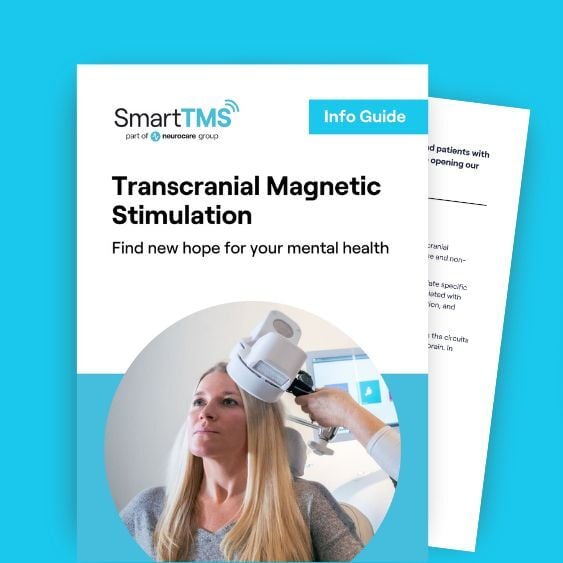
Transcranial Magnetic Stimulation (TMS) is a non-invasive brain stimulation therapy that uses magnetic pulses to target specific areas of the brain involved in OCD, depression, and anxiety.
Research has shown that people with OCD often have dysregulation in brain circuits responsible for habit formation, emotional regulation, and error monitoring. TMS aims to modulate these circuits, helping reduce symptom severity over time.
Potential Benefits of TMS for OCD
-
Reduction in obsessive thoughts
-
Decreased urge to perform compulsions
-
Improved emotional regulation
-
Reduced anxiety and depressive symptoms
-
No systemic side effects like medication
TMS for OCD is typically considered when symptoms have not responded adequately to therapy, medication, or a combination of both.
TMS for OCD, Depression, and Anxiety
At Smart TMS, we offer TMS for OCD alongside TMS for depression and TMS for anxiety, recognising that mental health conditions rarely exist in isolation. Treatment plans are personalised, evidence-based, and delivered by experienced clinicians within a supportive clinical environment.
For many individuals, TMS can provide renewed hope — particularly when traditional treatments have felt limited or overwhelming.
Support for OCD at Smart TMS
Living with OCD can feel isolating, but effective treatment options are available. At Smart TMS, we specialise in advanced, non-invasive treatments for mental health conditions, including OCD, depression, and anxiety.
If OCD is impacting your daily life, confidence, or wellbeing, our team is here to help you explore whether TMS may be a suitable option for you.
References
-
American Psychiatric Association. Diagnostic and Statistical Manual of Mental Disorders (DSM-5-TR). APA Publishing.
-
National Institute for Health and Care Excellence (NICE). Obsessive-Compulsive Disorder and Body Dysmorphic Disorder: Treatment.
-
World Health Organization. International Classification of Diseases (ICD-11).
-
Stein DJ, et al. “Obsessive–compulsive disorder.” The Lancet.
-
Carmi L, et al. “Clinical and electrophysiological outcomes of deep TMS for OCD.” World Psychiatry.
-
National Institute of Mental Health (NIMH). Obsessive-Compulsive Disorder.
-
McLaughlin NC, et al. “Neural correlates of OCD and treatment response.” Biological Psychiatry.