





International Day of Happiness
March 20, 2026 - Smart TMS


Rewiring Happiness: The Role of TMS in Restoring Wellbeing
Each year on March 20th, the world marks the International Day of Happiness, recognising that wellbeing and mental health are essential components of a flourishing society. While happiness may feel natural for some, for many individuals living with depression, it can feel distant or even impossible.
Understanding how happiness is generated in the brain—and what happens when these systems are disrupted—is key to restoring emotional wellbeing. Advances in neuroscience are now helping to bridge this gap, with innovative treatments like TMS for depression offering new hope.
The Neurobiology of Happiness
Happiness is often discussed as a psychological or philosophical concept, but it is also deeply rooted in the biology of the brain. Modern research shows that happiness arises from the interaction between neural reward circuits, neurochemical activity, and environmental influences.
At the neural level, happiness is strongly associated with the brain’s reward system. This network includes several interconnected brain regions, such as the nucleus accumbens, ventral pallidum, orbitofrontal cortex, insula, and anterior cingulate cortex, as well as cortical regulatory structures such as the dorsolateral prefrontal cortex (DLPFC) (Kringelbach & Berridge, 2010; Staudinger et al., 2011).
These areas process different types of rewards, including food, music, social interaction, and financial gain. Despite these experiences being very different, they activate the same neural circuits responsible for pleasure and motivation (Kringelbach & Berridge, 2010).
Reward processing involves three main components: liking, wanting, and learning (Kringelbach & Berridge, 2010). “Liking” refers to the experience of pleasure, “wanting” refers to the motivation to obtain a reward, and “learning” involves forming associations between behaviours and rewarding outcomes.
Neurochemistry also plays a key role in happiness. Dopamine is heavily implicated in the brain’s reward circuitry, while serotonin contributes to mood stability and feelings of satisfaction. Norepinephrine affects emotional arousal and attention, and endorphins produce pleasurable sensations and reduce pain (Dfarhud et al., 2014; Lomas et al., 2022).
Hormones also influence emotional states. High levels of cortisol, a stress hormone, are associated with lower wellbeing, while oxytocin promotes social bonding and trust (Dfarhud et al., 2014).
Beyond biology, environmental and social factors significantly influence happiness. Strong social connections, physical health, and lifestyle behaviours all play a role in supporting positive mental health and wellbeing (Bartels et al., 2022; Lomas et al., 2022).
Understanding how happiness is generated also helps us understand what happens when these systems become disrupted—particularly in depression.
The Neurobiology of Depression and Mental Health Disorders
Depression is not simply a low mood—it is a complex mental health condition involving disruptions in the brain’s reward system. Research shows that individuals with Major Depressive Disorder (MDD) experience reduced pleasure (anhedonia), decreased motivation, and impaired ability to respond to positive experiences (Cléry–Melin et al., 2019).
These changes are linked to dysfunction in key brain regions such as the striatum and prefrontal cortex (Zhao et al., 2024).
Neurochemical imbalances are also involved, particularly in dopamine (motivation), serotonin (mood regulation), and glutamate (neural communication) (Cléry–Melin et al., 2019). Importantly, these disruptions can persist even after symptoms improve, contributing to relapse.
Depression is also associated with dysregulation of the stress-response system, particularly the hypothalamic–pituitary–adrenal (HPA) axis. This can lead to chronically elevated cortisol levels and prolonged stress responses (Juruena et al., 2017).
Neuroimaging studies further show reduced activity in the dorsolateral prefrontal cortex (DLPFC), alongside altered connectivity in brain networks responsible for emotional regulation (Perrotta et al., 2025).
While traditional treatments such as medication and psychotherapy remain effective for many, around one-third of individuals experience treatment-resistant depression (TRD) (Al–Harbi., 2012). This has led to growing interest in advanced therapies like TMS for mental health conditions, particularly depression.
What Is TMS? A Modern Treatment for Depression
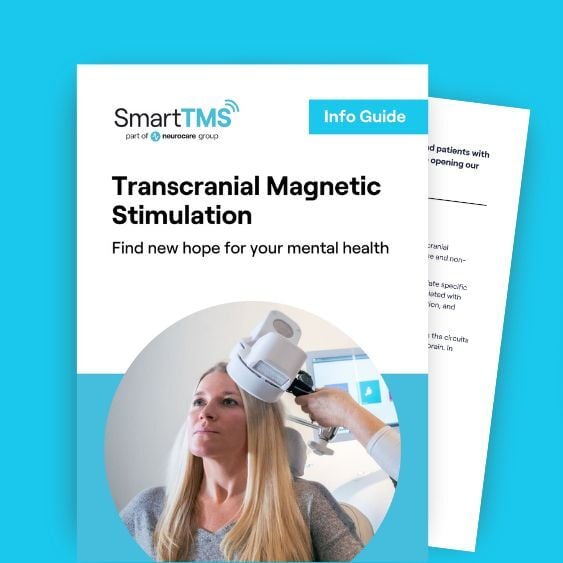
Transcranial Magnetic Stimulation (TMS)—also known as repetitive TMS (rTMS)—is a non-invasive brain stimulation therapy that uses magnetic pulses to stimulate targeted areas of the brain.
TMS for depression typically focuses on the left dorsolateral prefrontal cortex (DLPFC), an area shown to be underactive in people with depression and closely linked to mood regulation and reward processing (Downar et al., 2024).
Unlike medication, TMS therapy for depression works directly on the brain circuits involved in mood, making it a valuable option for individuals who have not responded to antidepressants.
How TMS Supports Mental Health and Wellbeing
Recent research using TMS combined with brain imaging techniques (fMRI and EEG) shows that TMS can improve connectivity within key brain networks involved in emotional regulation and cognitive control (He et al., 2025).
Clinical studies demonstrate that TMS for depression is significantly more effective than sham treatment in improving symptoms of treatment-resistant depression (Vida et al., 2023).
Different approaches to TMS have also proven effective:
- High-frequency stimulation of the left DLPFC
- Low-frequency stimulation of the right DLPFC
Both approaches can help rebalance brain activity and improve mood (Cao et al., 2018).
Emerging research into accelerated TMS protocols—where multiple sessions are delivered per day—also shows promising short-term and long-term improvements in depression severity (Shi et al., 2024).
Overall, TMS for mental health is a safe, well-tolerated, and evidence-based treatment that offers new hope for individuals living with depression.
Get in touch with Smart TMS to find out more about TMS treatment for different conditions.
A Reflection for the International Day of Happiness
On the International Day of Happiness, it is important to recognise that happiness is not simply a mindset—it is deeply connected to brain biology and access to effective mental health care.
Innovations such as TMS therapy for depression are transforming how we understand and treat mental health conditions by directly targeting the brain systems involved in mood and wellbeing.
For those living with depression, treatments like TMS are helping to make happiness feel possible again. And that is something worth celebrating—not just on the International Day of Happiness, but every day.
Written by Niamh, Smart TMS Dublin Practitioner
References
Al-Harbi, K. S. (2012). Treatment-resistant depression: therapeutic trends, challenges, and future directions. Patient preference and adherence, 369-388.
Bartels, M., Nes, R. B., Armitage, J. M., van de Wijer, M. P., de Vries, L. P., & Haworth, C. (2022). Exploring the biological basis for happiness.
Cao, X., Deng, C., Su, X., & Guo, Y. (2018). Response and remission rates following high-frequency vs. low-frequency repetitive transcranial magnetic stimulation (rTMS) over right DLPFC for treating major depressive disorder (MDD): a meta-analysis of randomized, double-blind trials. Frontiers in psychiatry, 9, 413.
Cléry-Melin, M. L., Jollant, F., & Gorwood, P. (2019). Reward systems and cognitions in Major Depressive Disorder. CNS spectrums, 24(1), 64-77.
Dfarhud, D., Malmir, M., & Khanahmadi, M. (2014). Happiness & health: the biological factors-systematic review article. Iranian journal of public health, 43(11), 1468.
He, H., Sun, X., Doose, J., Faller, J., McIntosh, J. R., Saber, G. T., ... & Sajda, P. (2025). TMS-induced modulation of brain networks and its associations to rTMS treatment for depression: a concurrent fMRI-EEG-TMS study. Brain stimulation.
Juruena, M. F., Cleare, A. J., & Young, A. H. (2017). The role of early life stress in HPA axis and depression. In Understanding Depression: Volume 1. Biomedical and Neurobiological Background (pp. 71-80). Singapore: Springer Singapore.
Kringelbach, M. L., & Berridge, K. C. (2010). The neuroscience of happiness and pleasure. Social Research: An International Quarterly, 77(2), 659-678.
Lomas, T., Bartels, M., Van De Weijer, M., Pluess, M., Hanson, J., & VanderWeele, T. J. (2022). The architecture of happiness. Emotion Review, 14(4), 288-309.
Marx, W., Penninx, B. W., Solmi, M., Furukawa, T. A., Firth, J., Carvalho, A. F., & Berk, M. (2023). Major depressive disorder. Nature Reviews Disease Primers, 9(1), 44.
Ng, Y. K. (2015). Some conceptual and methodological issues on happiness: lessons from evolutionary biology. The Singapore Economic Review, 60(04), 1540001.
Perrotta, G., Liberati, A. S., & Eleuteri, S. (2025). Neuroanatomical and Functional Correlates in Depressive Spectrum: A Narrative Review. Journal of Personalized Medicine, 15(10), 478.
Shi R, Wang Z, Yang D, Hu Y, Zhang Z, Lan D, Su Y, Wang Y. Short-term and long-term efficacy of accelerated transcranial magnetic stimulation for depression: a systematic review and meta-analysis. BMC Psychiatry. 2024 Feb 7;24(1):109. doi: 10.1186/s12888-024-05545-1. PMID: 38326789; PMCID: PMC10851556.
Staudinger, M. R., Erk, S., & Walter, H. (2011). Dorsolateral prefrontal cortex modulates striatal reward encoding during reappraisal of reward anticipation. Cerebral cortex, 21(11), 2578-2588.
Vida, R. G., Sághy, E., Bella, R., Kovács, S., Erdősi, D., Józwiak-Hagymásy, J., ... & Voros, V. (2023). Efficacy of repetitive transcranial magnetic stimulation (rTMS) adjunctive therapy for major depressive disorder (MDD) after two antidepressant treatment failures: meta-analysis of randomized sham-controlled trials. BMC psychiatry, 23(1), 1-11.
Zhao X, Wu S, Li X, Liu Z, Lu W, Lin K, Shao R. Common neural deficits across reward functions in major depression: a meta-analysis of fMRI studies. Psychol Med. 2024 Aug;54(11):2794-2806. doi: 10.1017/S0033291724001235. Epub 2024 May 23. PMID: 38777630.